Inventory Management | Inciflo – your Supply Chain Partner

What is Automatic Replenishment System and How it Works?
By || Inventory Management | 19 Min Read

Entering the auto replenishment system, a revolutionary solution that has transformed how companies manage their stock. Let’s delve into everything you need to know about automatic replenishment systems, from their definition and process to their benefits and impact on the supply chain.

Why Auto Replenishment is a Game-Changer in Inventory Management?

Inventory shrinkage, operational delays, and excess stock are some of the most pressing challenges businesses face today. A recent study revealed that nearly 43% of businesses struggle with inventory inaccuracies without automation. The automatic replenishment system addresses these pain points by automating the replenishment process, ensuring that stock levels are optimized in real-time.

With the growing complexity of supply chains, the need for real-time data and cost savings has made auto replenishment indispensable for businesses striving for efficiency.

What is Auto Replenishment?

Auto replenishment refers to the automated process of restocking inventory based on pre-set parameters like demand forecasts, and reorder points to maintain stock levels. 

For example,
e-commerce giants like Amazon use this system to ensure their high-demand products are automatically reordered when stock falls below a certain threshold. This seamless replenishment process reduces the risk of lost sales and improves customer satisfaction.

What is an Automatic Replenishment System?

An automatic replenishment system is a technology to automate reorder inventory replenishment by integrating with tools like ERP and WMS. Unlike manual approaches, this system ensures accuracy and efficiency by utilizing real-time inventory tracking, demand forecasting, and advanced algorithms.

Features of an Automatic Replenishment System:

  • Inventory tracking with real-time data monitoring.
  • Integration with supply chain tools.
  • Customizable replenishment rules.

Benefits:

  • Reduces excess inventory and operational costs.
  • Minimizes lead times for replenishment orders.
  • Enhances demand forecast accuracy.

Replenishment Operations In Manual Warehouses vs. Automated Warehouses

The differences between manual and automated replenishment systems are transformative, directly impacting operational efficiency, accuracy, and cost-effectiveness. Below is an in-depth comparison:


Metrics

Manual Replenishment

Automated Replenishment

Speed

Slow due to manual tracking and order processing

Fast as systems operate in real time with minimal delays


Error Rates

High, with frequent mistakes in stock counts and orders

Low, thanks to automation eliminating human errors


Cost

Expensive because of labor and inefficiencies

Cost-efficient by reducing labor needs and optimizing resources


Real-Time Data

Absent, relying on periodic checks

Available, offering continuous inventory visibility


For instance, industries like retail often face stockouts due to manual errors, whereas automated systems ensure real-time inventory tracking, reducing such risks.

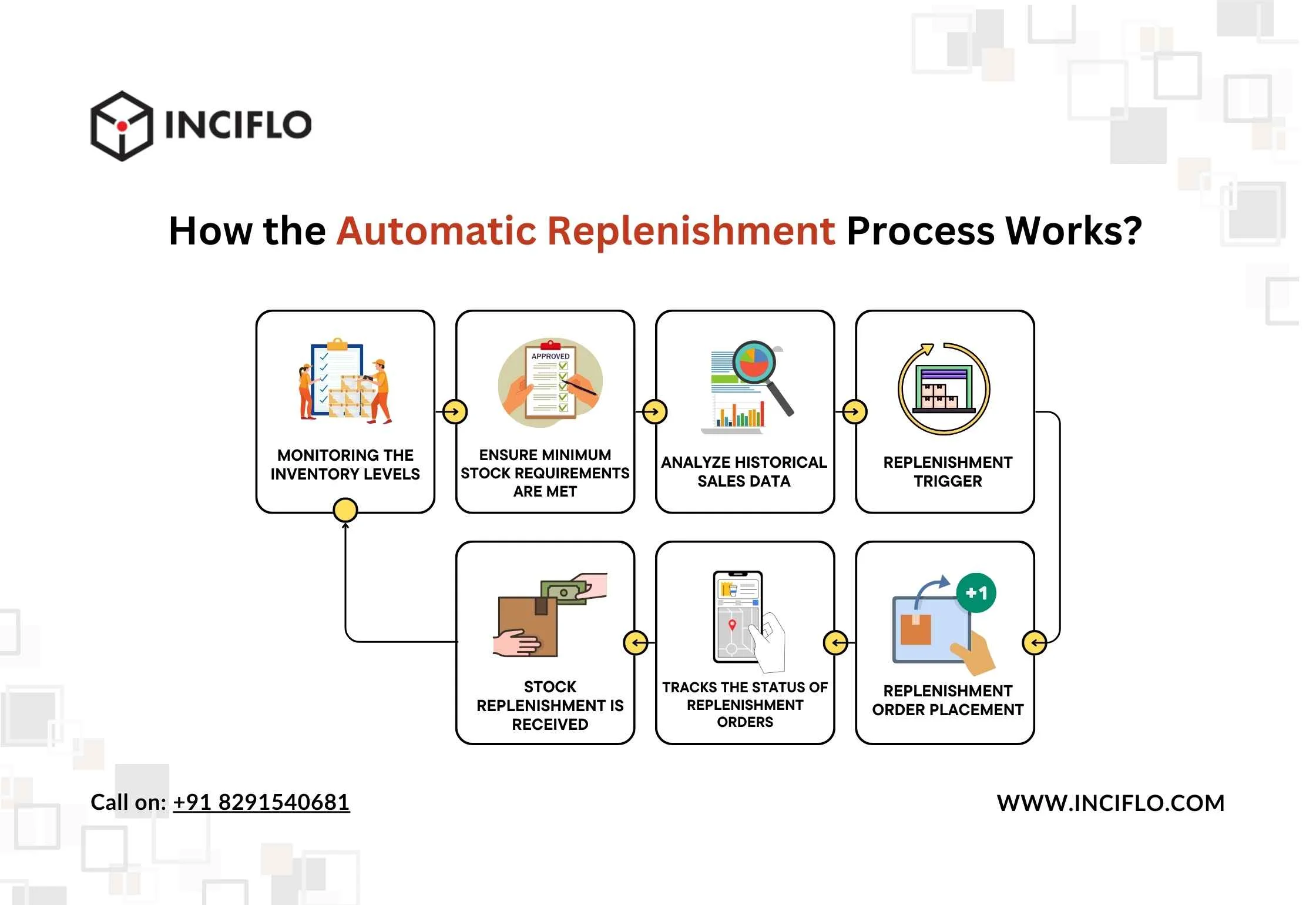
How the Auto Replenishment Process Works?

The replenishment process in an automatic system involves several stages:

1. Inventory Monitoring:

The system continuously tracks inventory levels in real time, monitoring stock movements and usage patterns.

2. Threshold Setting:

Predefined reorder points and safety stock levels are set based on business needs, ensuring minimum stock requirements are met.

3. Demand Forecasting:

Advanced algorithms analyze historical sales data, seasonality, and trends to predict future inventory requirements.

4. Replenishment Trigger:

When stock levels reach the reorder point, the system automatically generates a replenishment request or purchase order.

5. Order Placement:

The system sends the replenishment order to the appropriate supplier or vendor based on lead times and availability.

6. Real-Time Updates:

The system tracks the status of replenishment orders, providing real-time updates on order progress and expected delivery dates.

7. Stock Reconciliation:

Once the replenishment is received, the system updates inventory records to reflect the new stock levels, completing the cycle.

Hypothetical Case Study:

Consider a grocery store managing perishables. When milk stocks drop below a certain level, the automatic replenishment system triggers an order to restock, ensuring shelves are always stocked while minimizing waste.

Industries Benefiting from Automatic Replenishment

1. Retail:

Supermarkets utilize auto replenishment to manage shelf restocking efficiently, reducing lost sales due to stockouts.

2. Healthcare:

Hospitals and clinics ensure critical supplies like medicines and PPE are automatically reordered, enhancing patient care.

3. E-commerce:

Platforms managing high-SKU turnover benefit from optimized inventory levels and shorter lead times.

4. Agriculture:

Farmers leverage these systems for timely replenishment of seeds, fertilizers, and other essentials, ensuring smooth operations.

5. Manufacturing:

Production lines rely on auto replenishment to maintain a steady supply of Manufacturing raw materials, avoiding production halts.

Best Practices for an Automatic Replenishment System

1. Understand Your Business Needs

  • Identify inventory challenges like stockouts or overstocking.
  • Define goals such as reducing manual work or improving forecasting.

2. Evaluate Integration Capabilities

  • Ensure compatibility with existing systems (ERP, WMS, eCommerce).
  • Choose a system that syncs real-time data and is scalable.

3. Analyze Inventory Data & Forecasting Features

  • Look for demand forecasting features using historical data and predictive analytics.
  • Select systems with dynamic replenishment algorithms based on sales and lead times.

4. Consider User-Friendly Interfaces

  • Choose an intuitive, easy-to-use system.
  • Ensure it offers customization for your business needs.

5. Evaluate Supplier and Vendor Management Features

  • Look for ARS with vendor integration and automated order placement.
  • Optimize lead time management with supplier tracking.

6. Ensure Real-Time Reporting and Analytics

  • Choose an ARS with real-time reporting on stock levels and performance metrics.
  • Focus on key inventory KPIs like stockout rates and order fill rates.

7. Consider Costs and ROI

  • Weigh initial costs against potential savings and operational improvements.
  • Measure ROI through reduced stockouts and better inventory efficiency.

8. Customer Support and Service

  • Ensure robust training and customer support.
  • Look for a provider offering regular system updates and improvements.

Benefits, Challenges, and Disadvantages of Automatic Replenishment

Benefits:

  • Reduces Human Error: By automating calculations and order placements, businesses can eliminate mistakes associated with manual data entry and human oversight.

  • Saves Costs and Time: Automation streamlines operations, reduces labor costs, and accelerates the replenishment process, allowing businesses to focus resources elsewhere.

  • Optimizes Stock Levels: Ensures inventory is maintained at ideal levels, reducing instances of overstocking or understocking.

  • Enhances Customer Satisfaction: By preventing stockouts, businesses can fulfill customer demands promptly, improving reliability and trust.

Challenges:

  • High Initial Implementation Costs: Setting up an automatic replenishment system can require significant investment in software, hardware, and training.

  • Integration Issues: Businesses may face difficulties integrating the system with existing legacy platforms like older ERP or WMS solutions.

  • Resistance to Change: Employees accustomed to manual processes may be hesitant to adopt new technology, requiring additional training and change management efforts.

  • Data Accuracy Dependency: The system relies on accurate real-time data to function effectively. Poor data quality can lead to incorrect replenishment decisions.

Disadvantages:

  • Complex Setup and Maintenance: Regular updates and maintenance are necessary to keep the system running efficiently, which could incur ongoing costs.

  • Dependency on Technology: In case of system outages or technical failures, businesses might face disruptions in their inventory management.

  • Limited Flexibility for Unforeseen Events: Automated systems may struggle to adapt to sudden changes in demand or supply chain disruptions without manual intervention.

Quick Takeaways:

While the benefits of an automatic replenishment system—such as cost savings, efficiency, and optimized inventory—are significant, businesses must address the challenges of integration, training, and ongoing system maintenance to achieve success.

Types of Automatic Replenishment Systems

1. Replenishment by Quantity:

This system works by automatically placing an order when your stock falls below a certain level. It’s great for businesses that sell items at a steady pace, ensuring they always have just the right amount of inventory.

Example: Imagine a stationery shop that reorders 100 packs of paper as soon as the stock drops to 20. This way, they never run out.

2. Replenishment by Demand:

This system looks at past sales data and upcoming trends to decide how much stock to order. It’s perfect for businesses where customer demand changes often, helping avoid wasting money on too much stock or losing sales due to shortages.

Example: An online store expects more smartphone sales during the holiday season and increases stock based on these predictions.

3. Replenishment by Time Interval:

In this system, orders are placed at regular intervals, like weekly or monthly, regardless of how much stock is left. It’s a good option for businesses with predictable needs, like seasonal or perishable goods.

Example: A restaurant orders fresh vegetables every Monday, ensuring they always have enough for the week.

Real-World Examples of Replenishment Systems:

Brands like Oracle NetSuite and Inciflo helps businesses manage inventory by automatically real-time tracking and reordering stock. It’s easy to integrate with other business tools like accounting software.

These systems make it easier for businesses to stay organized, reduce waste, and save money by keeping inventory levels just right.

How Automatic Replenishment System Integrates with Other System?

The replenishment system integrates with ERP for order management, WMS for warehouse tracking, and IoT devices for real-time data collection. APIs facilitate seamless communication between these systems, ensuring an efficient replenishment process.

Example:

A retail chain integrates its replenishment system with IoT-enabled shelves to track stock levels and trigger orders in real time, reducing stockouts.

How Automatic Replenishment Transforms the Supply Chain?

Automatic replenishment enhances supply chain efficiency through:

  • Improved Demand Forecasting: Reduces excess inventory and ensures timely stock availability.
  • Reduced Lead Times: Speeds up the replenishment process, improving customer satisfaction.
  • Sustainability: Minimizes waste by aligning with just-in-time (JIT) inventory practices.

Example:

A manufacturer implementing auto replenishment reduces the bullwhip effect, improving collaboration with suppliers.

How Inciflo Optimizes Auto Replenishment for Your Business?

Inciflo’s automatic replenishment system streamlines inventory management by providing end-to-end visibility and real-time tracking. Its mobile-friendly interface and advanced analytics make it a top choice for businesses seeking efficiency.

  • End-to-End Inventory Visibility: Provides real-time tracking and a unified view of stock across multiple locations.
  • Mobile-Friendly Interface: Access replenishment data and manage inventory on-the-go with a mobile app scan based system.
  • Real-Time Replenishment Alerts: Automatically triggers restocking orders when stock levels fall below thresholds.
  • Advanced Analytics & Forecasting: Uses data-driven insights to predict demand and optimize reorder points.
  • Seamless Integration with Existing Systems: Integrates with SAP , WMS, and eCommerce platforms for real-time data synchronization.
  • Customizable Replenishment Rules: Allows businesses to set personalized replenishment parameters based on specific needs.
  • Cost Savings through Efficient Inventory Management: Reduces manual labor and optimizes stock levels to save costs.
  • Enhanced Supplier and Vendor Coordination: Automates order placement and tracks supplier lead times for better coordination.
  • Real-Time Reporting and Performance Metrics: Provides detailed reports and KPIs to support data-driven decision-making.
Success Story:

A retail client reduced operational costs by 30% and improved stock availability by 50% using Inciflo’s solution.

Conclusion

The auto replenishment system is no longer a luxury but a necessity in today’s competitive landscape. By optimizing inventory levels, reducing costs, and enhancing supply chain efficiency, businesses can achieve sustainable growth.

Ready to transform your inventory management? Contact us to learn how Inciflo can revolutionize your business!

Additional Insights: The Future of Automatic Replenishment

As technology evolves, future replenishment systems may incorporate:

  • AI and Machine Learning: To predict demand more accurately and personalize replenishment strategies.
  • Blockchain Technology: For enhanced transparency and trust in supply chain operations.
  • Robotics and Automation: For physical restocking tasks, further reducing human intervention.
Popular Posts

Discover more from Inventory Management | Inciflo - your Supply Chain Partner

Subscribe now to keep reading and get access to the full archive.

Continue reading